
Why Gender-Affirming Care Matters
....and how you can help


Imagine being a parent sitting in a doctor’s office, asking how best to support your child’s well-being. Or a clinician trying to practice medicine guided by care, evidence, and ethics. Or a young person simply trying to feel like they finally belong in their own body—only to be told that the care they need may no longer be an option because of federal policies. For transgender and gender-diverse people and their families, this is happening right now, even though gender-affirming care is a critical part of health care and well-being.
Evidence-based care and medical freedom is being undermined
Currently, in the U.S., policies are trying to shape what gender-affirming care is allowed and what research can be funded, regardless of medical consensus or individual needs. Here are just some recent examples:
Multiple states have passed or proposed restrictions on gender-affirming care for minors.
Multi-million dollar research grants are being cancelled for including “identity-based” language.
Just this week the House voted to pass the “Protect Children’s Innocence Act” which would make it a class C felony to treat minors with gender-affirming care. This could result in clinicians facing jail time if it passes.
The Centers for Medicare and Medicaid Services proposed two rules that would withhold federal funds from facilities that provide gender-affirming care for minors. One rule would prevent them from receiving ANY funding from Medicare or Medicaid programs.
Rodrigo Heng-Lehtinen, SVP of Public Engagement at Trevor Project says it best
“Everyone in this country should have access to the care they need to stay healthy, including transgender and nonbinary young people. Personal medical decisions ought to be made between patients, their doctors, and their families - not through a one-size-fits-all mandate from the federal government.”
What is gender-affirming care?
Some of you may not even know what is meant by the term gender-affirming care, so let’s talk about it! It has many meanings, but this post is focusing on it specifically in the context of transgender and non-binary people as that is what is being impacted right now.
Gender-affirming care happens inside and outside the clinic. This newsletter mainly addresses clinical care, but gender-affirming care also involves how children (and eventually transgender adults) are allowed to behave in all the places they move about. Gender-affirming care allows them to continue to look and behave in a way that feels most comfortable to them as they approach adolescence.
Gender-affirming care for children inside the clinic mainly seeks to preserve or prolong this innocent, unselfconscious, comfortable state of being for the kids who aren’t comfortable with what the outside world is expecting of their bodies and minds. One example of care at this point are puberty blockers. They hit the pause button on puberty and are reversible, giving children and their families more expansive and pressure-free time to navigate this challenging time of figuring out longer term plans.
Gender-affirming care includes a wide range of options for patients and their families. Specific examples include (but aren’t limited to):
Social support to exist as their true selves
Mental health support
Hormone therapy
Surgery
Facial hair removal
Voice modification
Chest binding
Many falsely assume (and therefore oppose) gender-affirming care because they think it only means surgery, while this is one option, it isn’t the only option. Let’s talk about surgery though...
Gender-affirming surgery
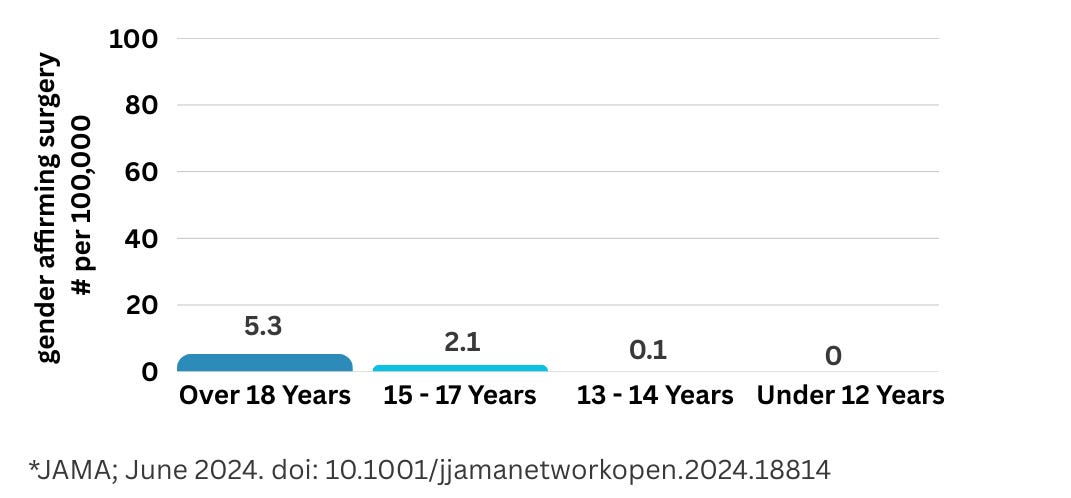
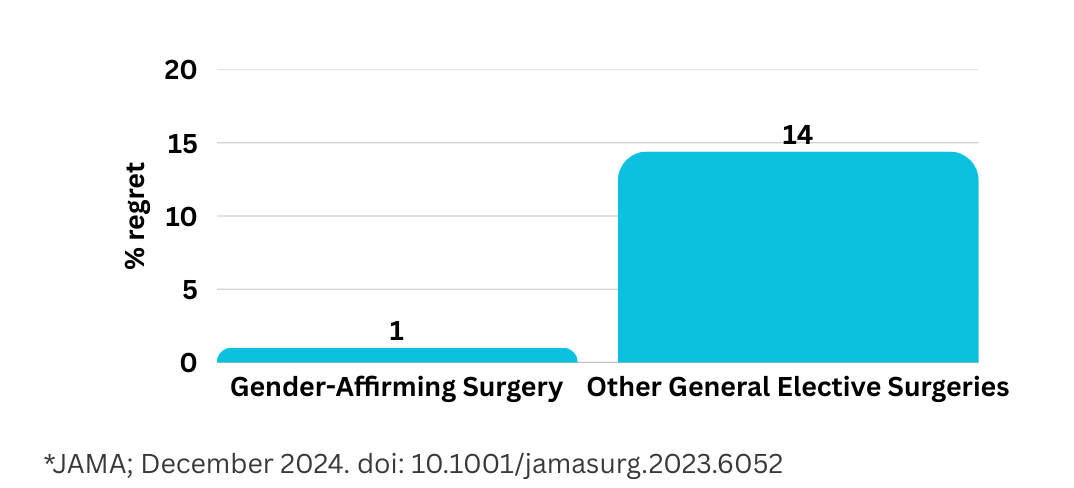
When you look at rates of surgery within the group of people who are transgender and gender diverse (TGD), rates are incredibly low overall, and especially low in youth. When it is used, data suggests that there are very few people who regret the choice. Pooled analyses show that regret makes up only around 1% of cases compared to 14% for other general elective surgeries. Ultimately, people should be allowed to make the decision that is best for them.
Why is gender-affirming care a public health issue?
Transgender and gender-diverse people already face higher rates of serious health hazards, including violence, barriers to inclusive health care, and significant impacts on mental health.
Data show that LGBTQ+ youth experience more violence than their cisgender and heterosexual peers, both at school and at home. More than half of transgender people experience intimate partner violence. Transgender people also face a disproportionate risk of cardiovascular disease and because of the way they’re stigmatized, they experience higher rates of depression, substance use, and suicide.
These cumulative risks take a steep and measurable toll on the trans and gender-diverse community. This means access to supportive, evidence-based care is critical.
Gender-affirming care improves health outcomes for trans people
Because of this, every very major U.S. medical association supports access to individualized, staged, and evidence-based care. Data show that gender-affirming interventions, like puberty blockers, significantly improve mental health. Transgender people experience better health outcomes (less depression, anxiety, suicide, exposure to violence) if they are able to receive the care they need.
What can you do?
Read and share stories of the lived experience: Many Americans may not know anyone who is transgender, or may not realize they do. Creating space to hear directly from transgender adults, young people and their families can shift understanding and build compassion and trust when the data alone does not. Liz is someone who grew up believing one thing about this group of people, and stories were key in helping her realize why what she was taught was wrong. Stories can truly help change minds, so you can help by sharing transgender stories. Here’s a few places to start finding them:
Stories shared on Cupofjo
Advocate nationally: We need to make sure the bill that just passed the house doesn’t pass the senate. Please call your representatives and let them know you oppose these policies.
Here is a sample script or text SIGN PHJBWV to 50409 to have an email directly sent to your reps!
Hello, my name is [Name], and I’m a constituent from [ZIP]. I’m calling to urge [Representative/Senator ___] to oppose efforts to restrict or criminalize gender-affirming care.
Medical care is individualized, evidence-based, and provided by medical professionals. Decisions about care should be made by patients, families, and doctors -not by the federal government.
Every major U.S. medical association supports access to this care, and denying it is associated with worse health outcomes. Please oppose policies that restrict gender-affirming care like the Protect Children’s Innocence Act and CMS funding restrictions. Thank you.
Advocate locally: Educate schools, youth programs, and other spaces that serve young people about the importance of gender-affirming care and support. Local action can have an immediate, meaningful impact by creating safer, more supportive communities.
Know and share support resources. Be ready to share crisis and support options like those below:
Learn more yourself: Here are some resources for further reading to learn more and help yourself become a better ally.
Ensuring Comprehensive Care and Support for Transgender and Gender-Diverse Children and Adolescents from the AAP.
Gender-affirming care is a public health imperative and saves lives. We all have a role to play. Please help us spread the word.
Xoxo,
Liz, MK, Anni, Nikki, Matthew & Haley

 | A guest post by
|
 | A guest post by
|
 | A guest post by
|
 | A guest post by
|
 | A guest post by
|