
When antibiotics fail, what comes next?
On bacteriophages, hope, more time, and the importance of science funding

I know I often talk about how so much of science and public health is invisible, and why that needs to change. Storytelling is one way to change that. I’ve been planning a series for a while now to bring stories like this one to you. My goal is to illustrate how research and public health create real benefits in the world, through the voices of scientists, patients, and public health workers. This is the first story, but not the last.
If you have a story you think I should tell, reach out at sciencewhizliz@gmail.com.
In 2012, a freshman named Seth Pinches at Providence College, working in the lab of Dr. Kathleen Cornely*, collected a soil sample as part of a class project. From that soil, he isolated a bacteriophage, also known as a phage. He named it ZoeJ, after his brand new niece.
In 2017, a 15-year-old girl named Isabelle Holdaway was sent home from a hospital in London to die. She had cystic fibrosis, a genetic disease that fills the lungs with mucus, and sets up a perfect environment for many bacterial infections. For eight years, she had been fighting multiple infections. One was caused by Mycobacterium abscessus (a relative to the bacterium that causes tuberculosis). Every antibiotic her doctors tried eventually stopped working.
Isabelle ended up needing a double lung transplant. It was her best hope, but the surgery ended up spreading the M. abscessus infection throughout her body. The infection even began to push through her skin leaving visible nodules.
She lost so much weight that her mother told a reporter for The Guardian that she was “literally like a skeleton.”
She went home on palliative care, out of options.

Antibiotic resistance is a major health issue
Antibiotics are an amazing tool to help fight bacterial infections, but bacteria are adaptable and can evolve ways to avoid them. The World Health Organization states that antibiotic resistance is one of the major global public health threats. We are seeing increasing rates of antibiotic resistant infections and complications. Resistance is now estimated to be involved in more than five million deaths a year worldwide, and will continue to grow.
All of this is happening with the backdrop of science being dismantled in the U.S. in ways we have never before seen. Solutions for antibiotic resistance are more important than ever, and if this destruction persists, they will become even harder to find.
Isabelle’s last hope – bacteriophage
Isabelle’s mom, Jo, was desperate for more options and did what many of us would do: she went online. She found information about phage treatment and asked Isabelle’s doctor if it was something they could try.
Phages are tiny viruses that infect bacteria and can sometimes kill them. They are found all over the world, and can harm bacteria, but not people. Research is being done to investigate their use as an alternative way to kill bacteria when antibiotics don’t work.
Luckily, Isabelle’s team was able to connect to Professor Graham Hatfull at the University of Pittsburgh, a scientist who has spent over three decades building one of the world’s largest collections of phages (and getting students involved).
Hatfull’s team began searching for phages that could kill the specific type of bacterium making Isabelle sick. They eventually identified three. One effectively killed the bacterium. The other two could infect the bacterium, but didn’t kill it.
The reason comes down to how some phages replicate. Like all viruses, phages must copy themselves inside a host cell. One strategy, called lysogenic replication, involves inserting their DNA directly into the bacterium’s DNA and lying dormant. The phage is then copied alongside the bacterium every time it divides without destroying its host.
Eventually, something (i.e. stress) triggers lytic replication. In this process, the phage is no longer hiding dormant. The phage reproduces, and exits the cell, killing it in the process.
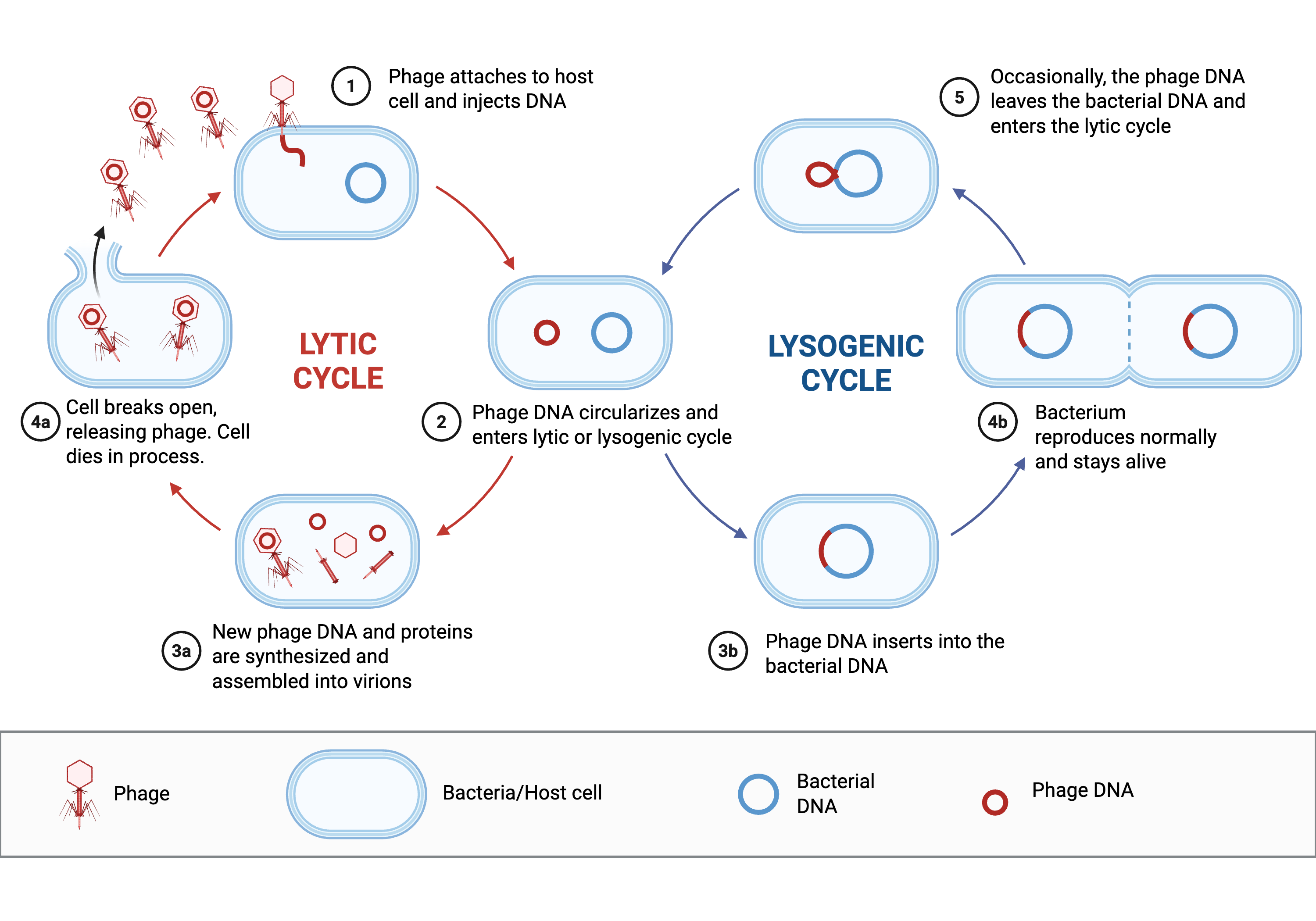
A specific gene acts as a repressor (i.e. a brake) that keeps phages in this lysogenic state. By using genetic engineering to remove that gene, scientists can switch phages to lytic, meaning they destroy the bacteria they infect.
That’s exactly what happened with two of the phages that could infect Isabelle’s bacteria. Once their repressor genes were removed, both became effective killers of her bacteria. One of them was ZoeJ, which Cornely had engineered during her sabbatical in Hatfull’s lab.
A Slow Miracle
In June 2018, Isabelle returned to the hospital to receive all three phages the Hatfull lab identified. The treatment was well tolerated, had minimal side effects, and worked!
Eventually, Isabelle’s surgical wound healed, her skin cleared, her liver function improved, and she began to gain weight. She was able to return to school, start to learn how to drive, and get a part-time job.
These findings were published in May 2019 in Nature Medicine as the first documented use of genetically engineered phages to treat a human infection.
Isabelle unfortunately passed away in 2022. The bacterium gradually mutated to avoid the phages she had been treated with, and new ones could not be found in time. Isabelle’s family still had to face the grief of a lost child, but science gave them four extra years.
Some people may say this means science failed, but it didn’t. More time is a gift, even if not the ending anyone wanted.
Phage therapy for antibiotic resistance needs continued investment and research before widespread human use, but it holds promise as we continue to grapple with the rise of resistance. Isabelle’s story will forever be a part of this legacy.
Why this matters now
Research doesn’t come with a crystal ball. This story is a critical reminder that we cannot always predict where research will lead, or how it may one day benefit us.
When Providence College freshman Pinches collected a soil sample in 2012, nobody imagined it would one day be shipped to another country to help give a teenager more time.
When Cornely applied a gene-editing technique during a sabbatical because she wanted to be able to teach her students new skills, she wasn’t aiming to help a patient. She was just doing the science she loved.
“I didn’t know it was going to save someone’s life,” Cornely reflected in an interview with me. “We did it because we wanted to learn more basic science about how these phages worked. But big advancements come from understanding this type of basic science.”
This story highlights some of the invisible infrastructure that supports scientific discovery:
Undergraduate students having a supportive training environment where they could work to isolate phages from soil.
Professors supporting their students and being driven to learn new techniques.
Decades of curiosity-driven research that eventually helped discover, and then engineer, ZoeJ and the other phages involved.
The people, supplies, and tools needed to do research.
All of these require sustained and reliable funding. NIH-funded grants helped support these discoveries and the training that brought people like Cornely and Pinches into this work in the first place.
The problems for science to tackle are many. Amazing tools exist and are being created everyday. Scientists are ready to help now, just like they were ready to help Isabelle.
The question is whether we, as a country, are willing to keep investing in the research that makes future gifts like this both possible and better.
Read my Boston Globe Op Ed here
My opinion piece with the Boston Globe came out yesterday, read it here. Let me know your thoughts!
Love,
Liz
*Thanks to Dr. Kathleen Cornely for sitting down with me to tell me this story, and her role in it.
You can support Liz’s work by upgrading to be a paid supporter of this substack or you can make a one time contribution of support here.
What an amazing story! It reminds me of the iceberg example, that the science we see is the top of the iceberg. But below the surface is the science that has come before, the foundation, to make that little tip above the water visible. Love stories like this!
you explained that very clearly and simply - thanks.
i really fear what lays ahead for science and the rest of us