
What We Fail to See
Science Gives Us Tools. Policy Decides Who Gets Them.

Stop reading this.
Lift your eyes from whatever screen you’re on and look around you. What do you see?
Maybe it’s something that makes you happy. Your favorite mug filled with hot coffee, your cat, your dog, your loved ones, or a beautiful view.
Maybe it’s something that brings stress. A messy kitchen, unfolded laundry, a hospital waiting room, work that is sucking your joy.
Now, imagine if you couldn’t clearly see those things anymore.
Eyesight is something so many of us take for granted every day.
When eyesight becomes a privilege
I am an older sister. Growing up, I spent a lot of time trying to take care of my little brother. Once he hit his pre-teen years, I noticed that he seemed to have really significant challenges navigating life, using cell phones, and reading. But I was still young myself, and didn’t quite know how to help him.
Eventually, the problem became severe enough that we were finally able to get him to see an eye doctor, where he was diagnosed with a degenerative eye disease called keratoconus.
I’m guessing you haven’t heard of this before. So, let me explain.
We all have corneas – which are the clear front layer of our eyes. Normally, corneas are dome shaped. This allows light to properly enter the eye and reach the retina. This allows us to see the world around us. In people with keratoconus, the cornea slowly begins to thin and bulges out into more of a cone shape.
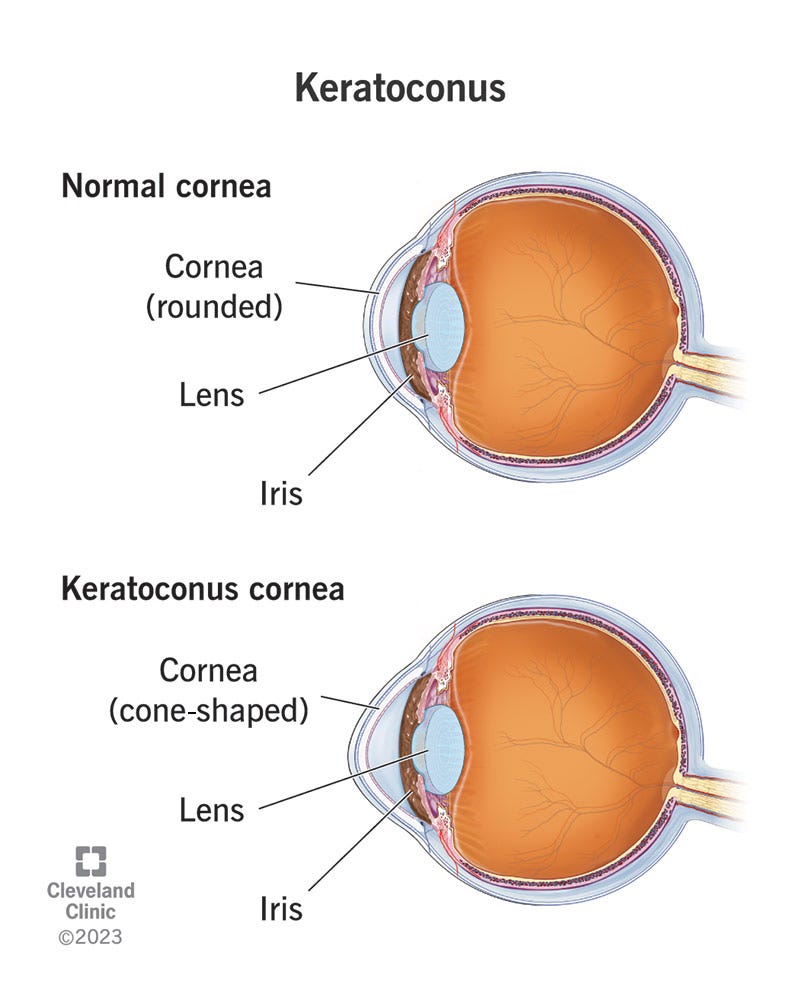
This change in the shape of the cornea distorts vision, making it hard for the person to see (see image below for an example).
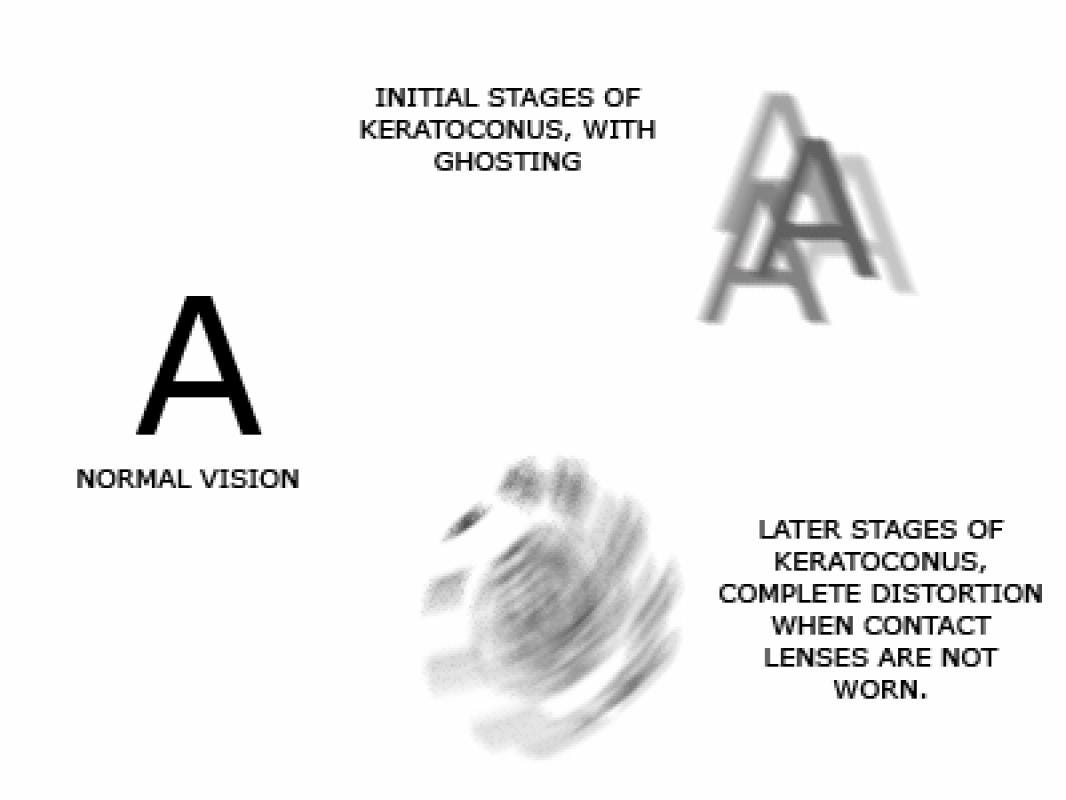
Keratonconus impacts about 50-230 people out of 100,000 and cannot be corrected with simple eyeglass prescriptions. Usually, treatments require special contact lenses, procedures to strengthen the cornea, or sometimes cornea transplants.
Early diagnosis is critical and can prevent severe vision loss. But that requires access to regular eye exams. Like many in low-income and medically distrustful families, we didn’t have that. So, he slipped through the cracks. By the time my brother was finally diagnosed, it was severe.
His options for treatment were expensive, and by this point we had very limited money to pay our portion of the costs even with health insurance. So, we were not able to intervene and his eyesight continued to get worse.
I remember being so frustrated, because I knew there were potential ways we could help him, but at barely 18 myself, I couldn’t get him access.
Eventually, he became a young adult, and he had an even harder time navigating life. He no longer had health insurance, and we worked hard to try to find thousands of dollars to pay for possible treatment options for him. Time kept passing, and his vision kept getting worse.
To use his phone, it would be smashed against his nose, and he’d be squinting as much as he could to try to make out words on the screen. He was too visually impaired to drive. Witnessing the challenges he faced broke my heart, and also made me deeply angry.
There were options, but he couldn’t access them. Instead, he struggled.
Science gives us the tools but policy determines who can access them
Science had done its part. There were multiple treatment options he could try. The barrier for us was not knowledge, but healthcare access.
That’s why the current debate over healthcare access matters. Congress is debating whether to extend the Affordable Care Act’s premium tax credits, which make insurance more affordable for millions of low and middle income Americans. These expanded credits are set to expire at the end of this year.
If they do, experts at the Kaiser Family Foundation estimate that average premiums for Marketplace coverage would more than double, and almost 5 million people could lose healthcare coverage entirely. And with several lawmakers again calling to repeal the ACA entirely, the U.S. could see the largest lack of healthcare access in a decade.
For families like mine growing up, those numbers aren’t abstract. Everyone deserves access to healthcare so they can live full, active and healthy lives.
Lack of healthcare access is the difference between diagnosing keratoconus early or missing it until it’s severe. It’s the difference between a young boy being able to see and navigate his world vs. being abandoned to struggle with education, jobs, and daily aspects of life. It’s the difference between a $20 specialist co-pay and a $500+ bill. It can be the difference between life and death, or the promise of science and the reality of not being able to access its benefits.
Understanding the Anger
I attended the American Public Health Association meeting last week. Everywhere I turned, I heard conversations related to lack of trust in science and public health, and confusion over the anger many people are encountering in pockets of the public discourse.
So, during the panel I was on, I brought up the fact that we shouldn’t be surprised because institutions and systems are failing people. My brother’s story is one of many personal examples I could share from my own family. We are not unique. Thousands of families could give you more examples.
Yes, science is amazing. So is public health.
It does improve lives.
It does lead to new technologies.
It does lead to new preventions, treatments, and cures.
But we have to admit that not everyone knows these things exist, and there are very real barriers for people being able to access these benefits. So, no wonder they’re distrustful and mad. I get it. I’ve been there.
I was SO angry and hurt for so long that there were options for my brother that were out of reach for him.
My brother is still angry about it, for good and understandable reasons. He finally, just in the last two years, has been able to access treatment. He just learned to drive in his early thirties.
His life could have been dramatically improved sooner. The options existed. They just didn’t exist for him.
Steps Toward Something Better
We cannot expect people to appreciate science or public health if:
They don’t know how it’s being used or how it benefits them because we haven’t communicated effectively.
They can’t access the benefits of these advances because of lack of healthcare, money, education or other systemic barriers.
So, we can start here. There are things we all can do – even if you’re not in these fields yourself. We need you regardless of your background and training.
You can:
Share and interact with our content so it reaches others online. The algorithm requires engagement to reach new people. Suggest others follow science communicators you trust and enjoy.
Talk to family and friends about the benefits you’ve experienced thanks to public health and science.
Advocate for policies that improve access for those who need it.
Contact your elected representatives (find how here), to let them know you oppose repealing ACA and losing subsidies that help people afford healthcare coverage.
Vision for Equity
We can see and rejoice in the progress that science has given us. You can read about one hopeful aspect of progress here that I wrote about for Sharon McMahon publication The Preamble.
So yes, we can see the hope, but we also must see the inequities. The millions of Americans without health insurance, the people waiting months or years for medical appointments, the people who have to choose between groceries or their needed medication, and the families quietly working through heaps of red tape.
Science is hope, but issues like this impact whether that hope reaches everyone. Tackling that is one of our ways forward.
I’m doing a lot of work these days, and I’m committed to keeping my science content freely available to everyone—but if you find value in what I share and have the means, I’d be so grateful if you considered upgrading to a paid subscription. If that’s not possible right now, no worries at all—I’m just glad you’re here. ❤️.

Such an important post.
Great article, Dr Marnik. I’m in the women’s caucus of APHA and see the exact same disconnect!