
What should we actually be building?
On cathedral building, smallpox and the long work of trust and building something better.

A few weeks ago I was having coffee with a friend and mentor. I was talking about my work and the goals I have for it to help build something better for the future. Somewhere in the middle of my rambling, he reminded me this is “cathedral building work.”
I’d never thought of the work in this way before. So, I sat with it for the rest of the day, and then went down a rabbit hole that turned into this newsletter.
Lack of trust
A few weeks ago, when so many people were worried about the hantavirus on MV Hondius, I was confronted by how little trust existed on both sides. In one internet bubble I saw people claiming this was another “liberal ploy”. There was zero trust that we were telling the truth, or wouldn’t impose restrictions on anyone they weren’t necessary for. In another bubble, I saw deep distrust that passengers would quarantine, and doubt that public health would actually intervene.
This isn’t entirely surprising. The 2026 Edelman Trust Barometer found that trust has moved past polarization into something called insularity. Which means it’s harder for people to trust those who are different from them. The report also found that just 32% believe the next generation will be better off.
We also see that Americans report lower trust in scientists since 2020. Only 65% of those who identify as republicans report a “fair amount” of trust in scientists vs. 90% of those who identify as democrat.
On top of that, the institutions built to do science and protect our health are being actively dismantled by this current administration.
It is also true that we need to reckon with the fact that the systems we had in place were not perfect. In many cases distrust is earned through systemic failures. But, this is not a reason to completely destroy all of science and public health in the United States. The reality of moving forward exists in the messy messy middle of these truths.
I say all of this (again, I know I’ve said it before) because rebuilding requires being honest about what didn’t work. I am worried that we, as a society, aren’t yet at that point.
The fire that made the cathedral better
Across history, cathedrals have typically taken decades, if not centuries, to build. This meant that the people who originally had the vision for building them weren’t always around to see the final product.
Roman Krznaric calls this cathedral thinking* which is:
“the practice of envisaging and embarking on projects with time horizons stretching decades and even centuries into the future…”
While diving into the history of cathedral building I encountered the Chartres Cathedral in France. It burned down in 1194 for the fifth time. Each time before it had also been rebuilt, but after the 1194 fire they did something different.
Earlier cathedrals were built with very thick internal gallery walls. These were necessary to hold all the weight of the stone structures above. There were few windows due to this, so the insides of the buildings were often quite dark and compressed.
This wasn’t necessarily the best way, but no one had found a better way, yet.
Those who began rebuilding the Chartres cathedral in 1194 used a new technique called the flying buttress. This is impressive, because often times it is far easier to rebuild things the way they were instead of envisioning something new.
This new method of construction helped bear the weight of the structure and allowed them to remove the thick interior walls. As a result, the building became stronger, with higher ceilings. This technique is how large stained glass windows were introduced into Chartres. All because of what the builders chose to do from the rubble.

History shows us this takes longer than we want it to
It took about 25 years to build Chartres in its current form, and that’s fast for cathedral building!
With the destruction we are currently witnessing to science and public health, the question can’t be how we get back to what we had, though I worry to many will be tempted as this is the “easier” path. But doing so risks ending back where we currently are.
Instead, we need to figure out which walls and pieces are actually necessary, and which were just thick because no one had figured out a better way yet.
Building trust or a better future is not a short-term project.
The history of science and public health itself shows us countless examples of people laying the foundation for outcomes they themselves may never see.
Smallpox eradication was a cathedral building moment
For centuries smallpox was estimated to kill 3 out of every 10 people infected. In 1801 Edward Jenner published his work showing that inoculating people with cowpox, a similar, but less deadly virus, protected people from smallpox.
In this 1801 paper he stated:
“The annihilation of the smallpox, the most dreadful scourge of the human species, must be the final result of this practice.”
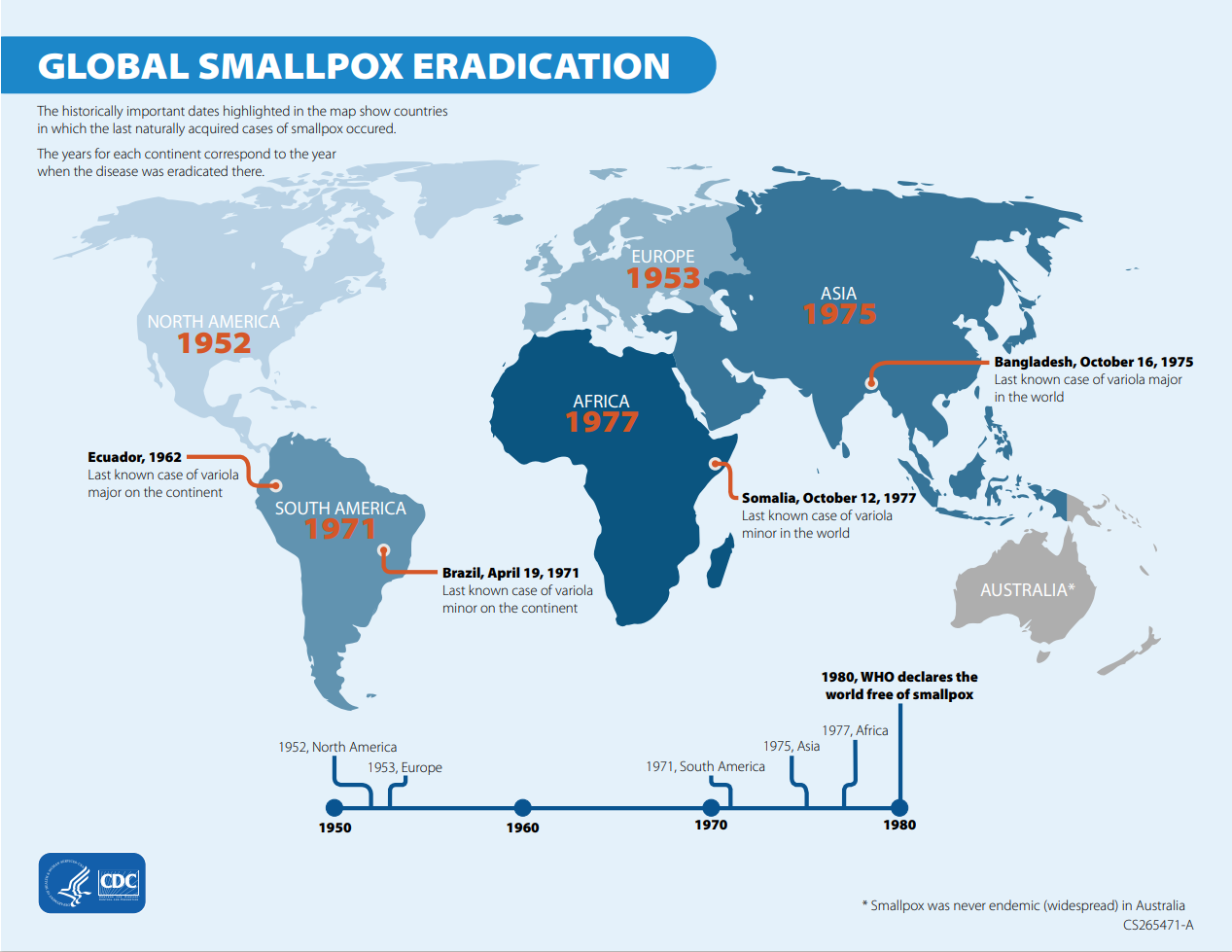
This is an outcome he hoped for, and that he set in motion, but he wasn’t around to actually witness it. He died in 1823, when smallpox was still causing deaths around the globe. Smallpox was eventually eliminated (no longer circulating in this specific area) from the United States in 1952, but it was still circulating in other parts of the world.
In 1959 the World Health Organization launched a global eradication campaign, but it suffered from many issues such as lack of funds and vaccine shortages. They renewed their efforts in 1967.
Finally, in 1977, smallpox was eradicated (no longer circulating anywhere on earth).
From Jenner’s paper to finally achieving smallpox eradication took 154 years. And it took countless people, many of whose names we will never know. Thanks to all of them we no longer have to worry about smallpox.
Stop just talking
Here’s an important caveat though. There are also many cathedrals that never get built. The plans are discussed at length. Everyone in the room likes the idea, but no one picks up the tools and actually gets to work.
The builders didn’t convene summits for years before setting to work rebuilding Chartres. They just started building rapidly after the fire.
So here is the question I now ask myself before I say yes to something: will this help lead to actual building, not just more talking? If not, perhaps my time and attention could be best used elsewhere.
I am not against talking and planning. We need to discuss the problem long enough to understand it, and we need to include all types of people in this process of planning and building. At some point though, we have to stop just talking and pick up a stone, some tools, and get to work.
The stone in front of you
When I was reminded that this moment requires cathedral building work. I think my friend meant it as permission to rest and pace myself, because right now it all feels urgent. He was right about that.
But I’ve also come to think it means something more. It also means that every time you lift a stone you ask whether the work is being done in a way that will really lead to your goals for the future.
In other words:
Is this reaching the people outside the room, or just the people already convinced?
Are we building community trust, or just expert consensus?
Does this leave someone’s health, knowledge, life, or sense of agency better off? Can I name who?
Is this strengthening a foundation that the next generation can build on, or does it only matter this news cycle?
Am I actually trying to be part of the solution or just talking?
The type of work looks different for everyone, but all of us have a role.
For a scientist it might mean publishing their findings and implications in plain language, or showing up to a school board meeting.
For a parent or family member it might mean the conversation at the school gate or dinner table.
For a local official it might mean defending a policy that protects the most marginalized.
It may not be glamorous or full of recognition, but it is part of the work.
The question in the rubble
So yes, whatever is being dismantled by the current administration right now will need to be rebuilt. However, we need to resist the urge to just go back to the exact way things were when the fire clears.
We first must figure out what is truly foundational and worked well, what needs to be built differently from the ground up (e.g. more transparent, more community-rooted, more honest about its own limits), and mobilize enough people to keep showing up to do the work, even if the timeline may mean none of us get to see all of it.
The fire at Chartres in 1194 was the fifth fire on that site. This time, when rebuilding, they used a new method that changed it for the better. The difference this fifth time was the decision made by those standing in that rubble, to ask the harder question:
What should this structure actually be and what do we need to do differently in the rebuilding?
This question is being asked of all of us right now, because we too have the opportunity to build something better for the future.
Lastly, I want to leave you with this quote that I’m keeping close as a reminder these days.
“The future is not some place we are going to, but one we are creating. The paths to it are not found, but made; and the activity of making them changes both the maker and the destination.” - Peter Ellyard
Onward to a better future we are building together,
Liz
P.S. Please share with me your thoughts and what you’re doing. What would you like to see the future of science and public health look like? We all have a role to play. I believe we can do it together.
You can support Liz’s work by upgrading to be a paid supporter of this substack or you can make a one time contribution of support here.
Additional references
*Greta Thunberg also referred to this “cathedral thinking” concept in her 2019 speech to the European Parliment.
My thoughts? Until we have a public health system which *actually respects science*, we won't have a public health system.
Have you read the most important article in the 21st century? It's this one (via archive.org)
web.archive.org/web/20210513100206/https://www.wired.com/story/the-teeny-tiny-scientific-screwup-that-helped-covid-kill/
I have a zillion more citations to prove airborne transmission (by aerosols) and the need for respirator masks (N95 or better), but here's one:
https://web.archive.org/web/20200825142459/https://www.medscape.com/viewarticle/934837
This one's very good, it's the one which convinced me.
WHO is STILL lying about airborne transmission. Of everything. Covid, influenza, RSV, hantavirus, Ebola. They've had the information since 2020. They lie, lie, lie, lie, lie, and they tell health care workers to go unmasked. For Ebola, they're handing out crappy "surgical" masks (which should be outlawed) instead of N95s. For hanta, they're sending patients to mingle unmasked. It's complete madness.
Step one, we have to get public health to listen to science. That's why I joined the World Health Network (note, "Network", not "Organization"). https://whn.global/
I love this newsletter! I think the transparency you mentioned, particularly for what’s known, what’s hypothesis, what’s hope, etc is invaluable for rebuilding trust