
It's not fair
Reflections on who is given help...who isn't...and why it matters

Why me?
This is what I wonder when I see glimpses of what my life could have been like.
The high school student who had potential but never got to see it come to fruition because nobody told them that they could do it or supported them in figuring out how. The college student who dropped out because it was too much to have to juggle a full-time job with full-time school. The parent who is wandering through the grocery aisle, counting up the cost of all the food in their cart, knowing that they’ll have to skip meals or maybe their own medical care, so their kids can eat. The unhoused person who is currently living out of their car. The person who’s diagnosed with a serious medical condition far too late because they didn’t have health insurance and couldn’t afford medical care.
In another life all of those people could have been me.
This essay is essentially a written version of my online ramblings from the other day that you can watch if you’d rather.
I’ve shared some about how my childhood wasn’t easy. So, when I look at the news, when I scroll social media, when I catch glimpses of things happening in the world around me, I wonder if there’s a parallel universe where the things that helped me get to where I am today didn’t happen and I ended up somewhere else.
It’s not fair when I think about those who are given chances in life, and those who aren’t, because the reality is that there are so many factors, some that are beyond what a person can control, that can impact their life outcomes.
These factors are called social determinants.
What are social determinants of health?
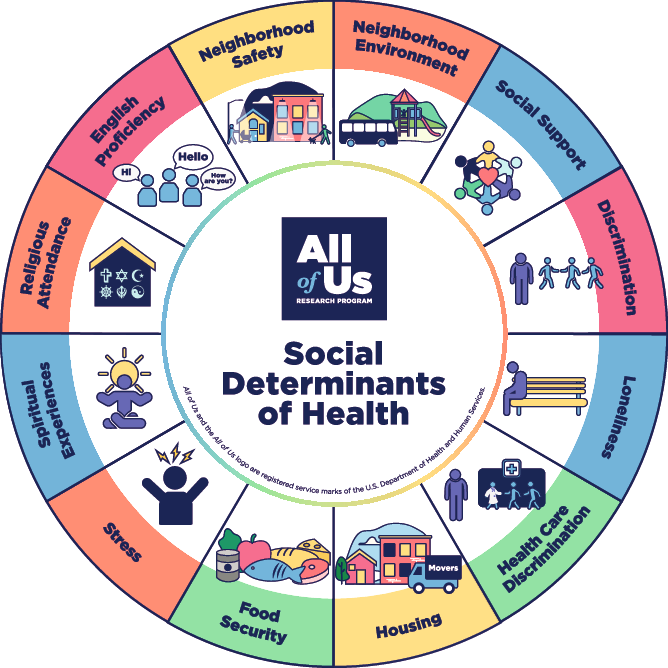
Social determinants of health are often talked about in the context of health outcomes but the reality is that they impact so many areas and they’re all connected. Social determinants include income, employment, education, food access, zip code, access to safe housing, health insurance coverage, quality of care, discrimination, racism, community engagement and more.
These factors impact people’s life expectancy, quality of life, rates of chronic illnesses, mental health and their ability to access things like education in the first place.
It’s not just bootstraps
Sometimes it’s easy for people to focus on those people like me who got out of less-than-stellar life circumstances. Some use us as examples of people being able to pull themselves up by their bootstraps. The underlying assumption is that everyone can do the same if they just work hard. That’s a lie.
Yes, I put in a lot of really hard work to get to where I am today, but none of that would have been enough on its own.
If a teacher hadn’t seen me in high school and supported my process of applying to college I wouldn’t have been able to go. If college professors hadn’t supported me in leaving my mom’s house and buying a car so I could move to Maine I never would have gotten a PhD or met my husband.
If I had been a different color, or more challenging to work with temperament-wise, if I had gone to a different school, been born in a different town, a different city, a different country — my story could have turned out entirely different.
I see these unequal opportunities playing out in my own family now. It’s really hard for me to not feel like I don’t deserve all that I have — why was I the one helped when others in my family were deemed “too much of a nuisance.”
It’s not fair because it should be all of us.
Systems fail
The reality is that the systems in our country are not serving all people equally or well. There are so many people who are failed, or can’t even access, systems of support every single day. That’s why social determinants of health exist in the first place. These inequalities are real and are perpetuated by our systems of power.
This is why I understand why many are angry. I understand why they don’t trust systems, or institutions, or people with power. Because while I have been supported by amazing people, I also have been failed by many systems and institutions. I also still see people who are biologically related to me be failed by them, time and time again.
Even now, as somebody with a PhD who no longer worries about buying groceries, I still can’t quite figure out how to navigate systems to help make sure the people I love have what they need to be healthy, happy, and thriving. If it’s this hard for me now, as somebody with immense privilege, how much harder is it for those without that?
The reality is we are all just one accident, bad decision, medical diagnosis, lost job, or bad luck day away from potentially needing help too, and not being able to access it.
Temptations of quick fixes
This is also why I understand and have deep compassion for those who are attracted to quick, simple fixes. Take out red food dye. Eat more protein. Exercise. Take out seed oils and it will all be fine.
Those types of changes are quick, but they don’t actually change the systems that got us here in the first place. And they certainly don’t help the people who need help the most – those who are poor, unhoused, don’t know how to apply to college (or can’t), living paycheck to paycheck, can’t afford their medical care, and don’t know what to do next.
Yes, they’re being sold causes and solutions that may not be true. Removing red food dye isn’t going to make them healthier. Access to health insurance and fresh food would help. But when you’re in an echo chamber, struggling, and seeing only one type of narrative, it shouldn’t be surprising that people believe it.
If experts, institutions and systems want to earn back trust (or earn it for the first time with some groups) then we need to help people with the issues they’re actually facing in everyday life.
Bottom Line
Systems failed me, and so did many people, but I was also graciously helped by many others who had no obligation to, and did it anyways. I am eternally grateful for them, but I will keep sitting here thinking that I didn’t deserve it. Not because I wasn’t deserving of help, but because there are far too many other people who deserve the help and support just as much as I did – and they don’t get it.
My call to action to you today is be the hand extended to someone else in whatever way is doable for you. Maybe its buying McDonalds for the man who is unhoused and asking for help on the corner, maybe its donating to the local food pantry, maybe its offering to babysit your neighbors kids so the single mom working many hours can get some time alone for a walk, maybe it’s helping the first generation student do their college applications. It can be whatever is in your capacity. It takes time to change systems at the top, but in the meanwhile we can all do what we can, where we can, for those around us.
Xoxo,
Liz
You can become a paid supporter of this substack or you can make a one time contribution of support here.

Thank you for this wonderful introspection Liz, for the inspiring call to action, and for all your science writing. My experience with the social determinants of health (as an inner-city primary care doctor, public health official, and leading a health equity collaborative for hospital executives) is that although the language may be updated to "drivers" vs. "determinants", if someone doesn't follow your exhortation to help others, these challenges do determine outcomes. I'm glad to hear your story. Thanks for sharing your hard-won wisdom.
As AI takes over more and more jobs, all of us are losing the friendly voiced human at the other end of a phone call to “ customer (no) service” , the check out person at our grocery store , or gas station, etc.
We are losing face to face contact and communication daily. In the losing , we distance ourselves from understanding other’s points of view and without realizing it we lose parts of our humanity. We lose kindness, patience, caring and understanding.
We are forgetting that AI can only be as good as the information fed into computers. We are forgetting that in order to have AI, good people lose their jobs , that AI uses much needed energy and water, and we do not have boundaries in place for how AI is being used.
Those who will be getting help in order to become doctors , etc in the future will be few and far between because AI has dismantled agencies that provided grants, scholarships, internships for our bright upcoming youth.
God help us.