
A Scientist's View on Hope
Let's end 2025 with intention and understanding that we can help make change. And yes, there is some science to back up hope.

This may be my longest newsletter ever. I hope you make it to the end to read the places I and others find hope right now, because we all need hope to continue on in the new year. I know we can change the world, one small act at a time. Thanks for being here. <3
In fall of 2010 I was sitting in my car outside the mall, papers spread across my lap. I was trying to prepare for my advanced genetics class while my mom and brother shopped inside. This was the only time I had to study. I had just gotten off work and then had to drive my family everywhere they needed to go (neither my mother or brother could drive).
The concepts blurred together. I couldn’t remember anything I just read. I started to cry in the parking lot. I was in my senior year of college, and I wanted to go to graduate school. But at that moment it felt impossible. I was working at least twenty hours a week, going to school full time, and helping support my family. I was exhausted and unable to see a path forward.
So, I came very close to quitting college altogether. I felt trapped, overwhelmed, and convinced that no matter how hard I tried, it wouldn’t be enough. How was I going to afford graduate school applications? How would I then afford to move away and start a new life all by myself? How could I leave my family without support?
So, what changed? I wrote more about some of the events that came next here, but a group of professors noticed I was drowning and stepped in. They didn’t magically fix all of my circumstances, but they provided support and helped me see that there was a path forward that I could, in fact, take. They helped me see that I could make the choice. In these ways, they helped me find hope.
There were still really hard days, but I finished college and left for graduate school several months later.
I then almost quit graduate school a hundred times that first year. I didn’t feel smart enough to be there. I was lonely. I was worried about my family who were struggling to survive in my absence.
But I chose to keep going. I chose to find hope in the encouragement of those professors who stayed in touch. I chose to find hope in the new friends I slowly began to make. I chose to find hope in the beauty of the new area I was in. I chose to find hope in the supportive words from the new mentors I was finding. So I kept going, buoyed by hard work and hope that I could find new ways forward.
That wasn’t the only time I have struggled to find hope. In all of my experience thus far, hope hasn’t been naïve optimism, delusion or a miracle cure. You can see and acknowledge the hard things, but hope has been necessary for me to keep doing the work.
Before I share how I, and others, find hope now, I want to dive a bit into what hope is, and some of the science on its impacts.

What is hope anyway?
When considering hope, I really love this quote I came across in The Conversation by Everette Worthington:
“First, hope is not Pollyannaish optimism – the assumption that a positive outcome is inevitable. Instead, hope is a motivation to persevere toward a goal or end state, even if we’re skeptical that a positive outcome is likely. Psychologists tell us hope involves activity, a can-do attitude and a belief that we have a pathway to our desired outcome. Hope is the willpower to change and the way-power to bring about that change.”
Psychologist Charles Snyder, defined hope as consisting of two beliefs. 1) that you have the ability to act (agency) and 2) that there are ways to meet the goal/desired outcome (pathways forward).
In my story above, I was able to find hope when those professors helped me see that I could make the hard choice and that there were pathways forward. Yes, they were difficult and success wasn’t guaranteed, but possibility existed.
What does science say about hope?
Research shows that hope has real and tangible impacts. Hope has been found to have positive impacts on things like happiness, work performance, life satisfaction, relationships, belonging and mental health. It also has been associated with positive impacts for people with chronic pain, chronic illness, cancer and other medical conditions. I am not saying that hope cures disease, but hope can help people cope, endure, adapt, and progress forward while pursuing the treatments that may help cure or treat their illness.
In educational settings, students with higher hope tend to perform better academically both in primary education settings (K-12), and in college. This seems to be maintained even when researchers controlled for other possible factors like prior performance, anxiety and optimism. Hope also has been associated with improved performance among athletes.
Beyond these types of personal benefits, hope is also associated with collective community benefits such as increased community service and participation in community actions that may help address societal issues such as climate change.
Perhaps most importantly, hope isn’t something you just do or don’t have. It is something we can all strengthen, learn and practice.
Where I find hope
There are some days I DO feel entirely overwhelmed and hopeless. There are days I cry in the car because it’s all too much to hold. But then I choose to be hopeful by reflecting on some of the things I mention below. I also have a good therapist, an amazing husband, and habits, like running, to support my physical and mental health in other ways. I encourage us all to consider those factors as crucial to our work as well.
Some places I find hope:
In knowing that people can change. I know they can because I have changed. I used to believe and think things that embarrass me now. I am walking proof that change is possible. People changing can lead to families changing, which can lead to communities changing, which can lead to changes even bigger. No one can convince me things can’t change because I’ve lived it and seen it in myself. This brings me immense hope.
In reading stories and meaningful words: I find a lot of hope and solace in poetry, books and stories. For example, I find hope in other people’s stories of change. I recently have had conversations with many people who, like me, grew up anti-science and changed. I hope to talk more about this in 2026! If you like to read hopeful things you can find a bit of hope through science in this article I wrote for The Preamble or this one I wrote here about some science advances bringing me hope.
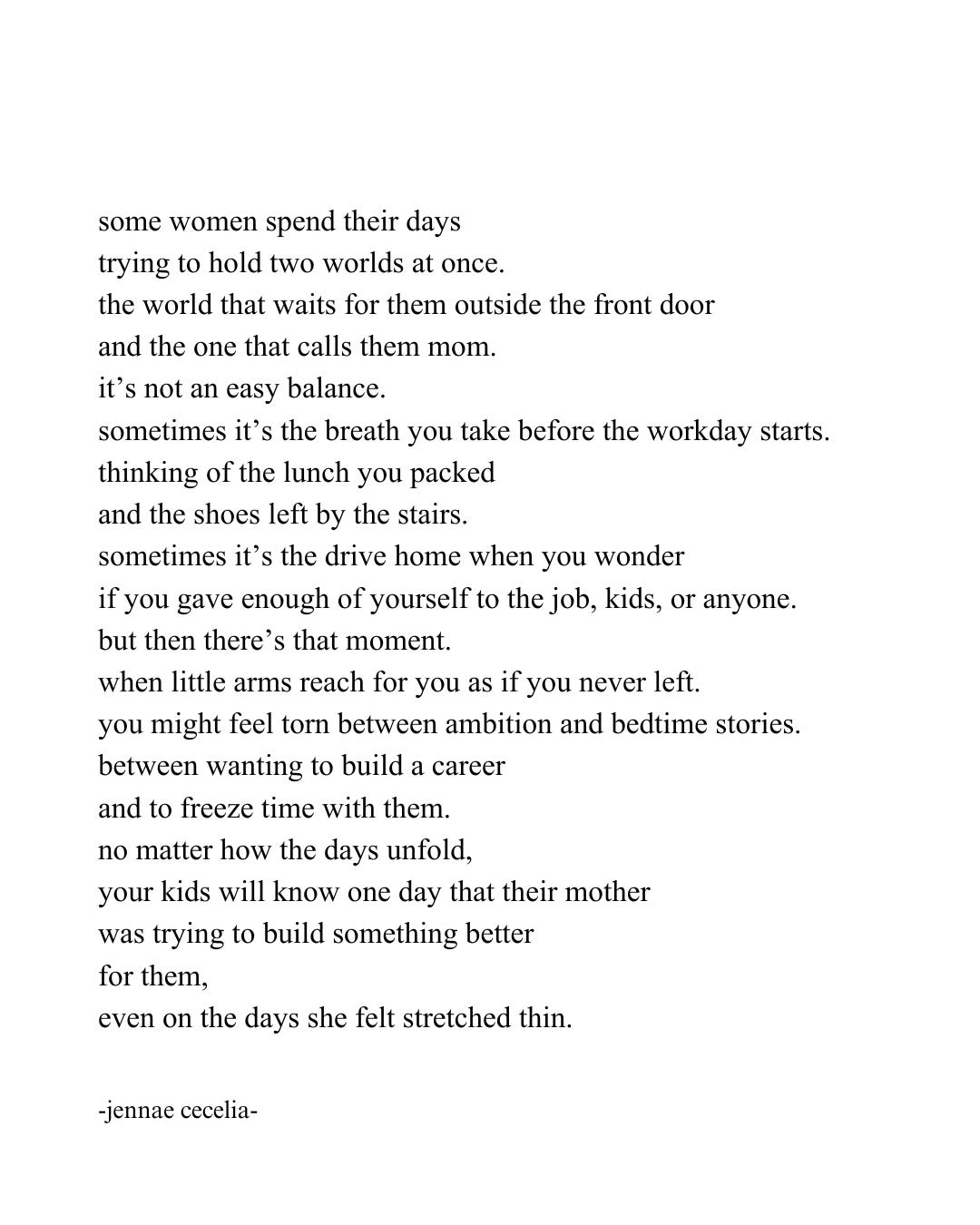
In spending time with my kids. Every day I wake up to the sound of my two kids chattering away, sometimes at five in the morning (less fun). In them I see the possibilities of a kinder, more caring future. They are my biggest reason for hoping and doing the work that I do. I ordered a few custom poems from Jennae Cecelia Poetry & Poems this year. One was for moms, myself included, doing hard work to balance it all, while desiring to make the future better for our kiddos. Sharing it below in case it also helps you find hope, like it did me.
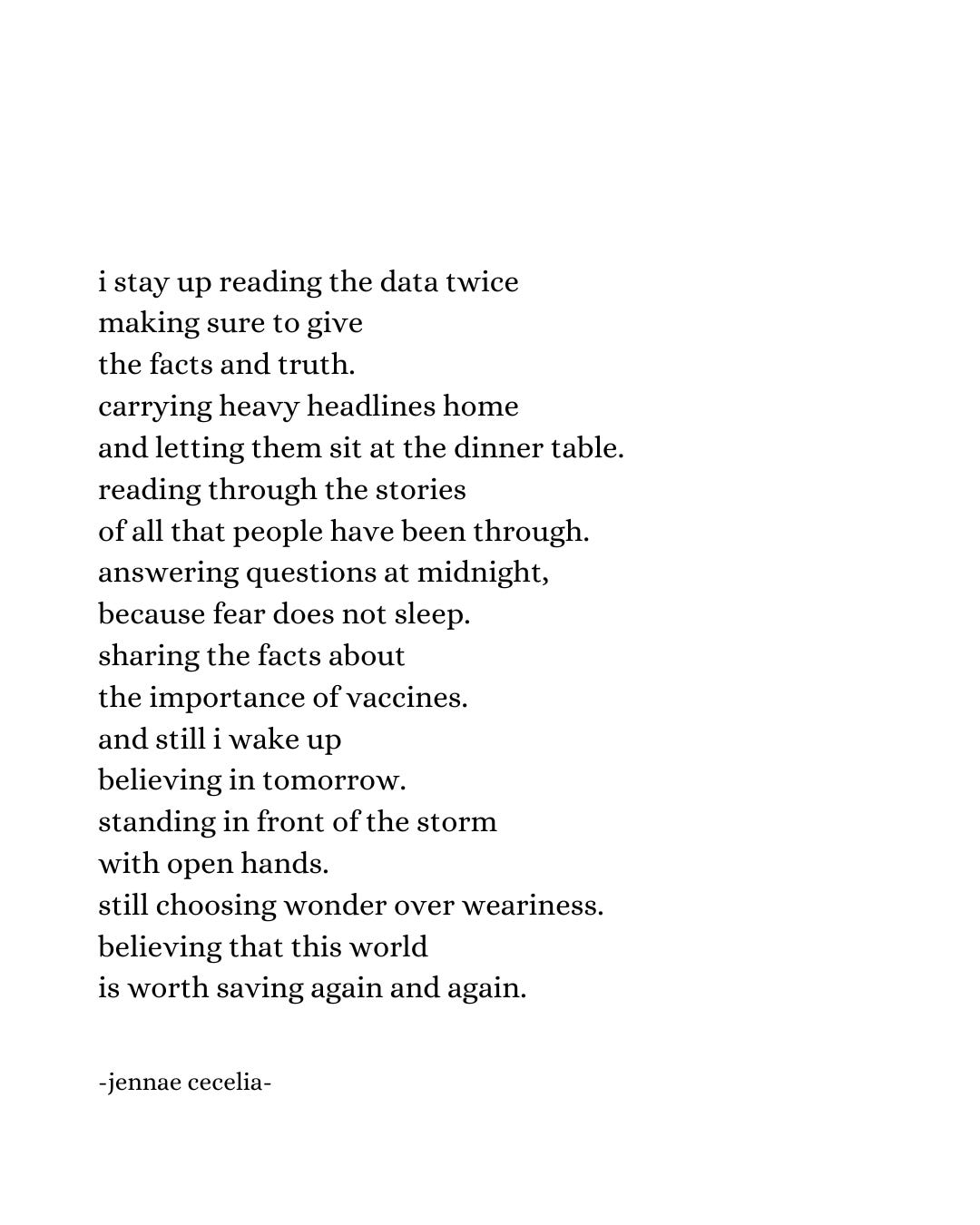
In noticing the helpers. Now, more than ever. I see the helpers. I see my fellow science communicators spending hours and hours (of largely uncompensated labor) to deliver information, to combat lies, to mitigate harms as public health and federal science systems are destroyed. Their work and their friendship give me hope. I also see helpers in my community making sure people have food, a warm bed and care that they need. I see people across the country doing what they can in big and small ways. In all these people I find hope. Another poem I requested from Jennae Cecelia Poetry & Poems was for my fellow science communicators, it illustrates a lot of where I find hope in this work. We are doing it because we believe a better future is possible.
In taking action. I find tremendous hope in doing. The problems are big. But doing what I can, where I can, and how I can, gives me hope that I am at least making my corner of the world a bit safer and kinder.
Where do others find hope?
I recently asked some of my friends and followers to tell me where they find hope. Below are themes that I saw repeated over and over in the more than 150 answers I received.
In our children, who are working on building a better future, and also worth our efforts towards giving them one.
In our jobs or volunteer work that actively makes things better for the people in our area.
In building the future we wish to exist.
In the small actions we take (and see others take) to improve and serve our communities.
In watching science communicators, medical professionals and public health officials push back and speak up.
In the positive comments and stories from people who have been impacted by our work.
In our faith or spirituality.
In nature and the time we spend enjoying it.
In finding a community of like-minded people working towards similar goals.
A few notable quotes:
“After years of researching misinformation and extremism, it is quite tempting to be cynical, especially in the world we find ourselves in today. However, I find hope by looking for the good.
Mr. Rogers shared that his mother would tell him to “look for the helpers” during frightening times, and I think about that a lot. When I look at our world, I make a deliberate effort to notice the people who are quietly doing good such as teachers helping students, doctors helping their patients, volunteers showing up for their communities, and anyone who does a small act of kindness. These people typically don’t go viral, but they’re everywhere.
And on a broader scale, I remind myself that human beings are still a very young species, and civilization itself, the idea of structured societies, rights, medicine, literacy, democracy, is barely a blink in Earth’s history. We are still learning how to be human together. Progress is messy and nonlinear, but if you step back far enough, the long arc does bend toward more equity, more justice, and more dignity for more people.
I’ve seen enough to believe that despite everything, we’re not doomed to repeat the worst parts of ourselves. We’re capable of learning. We’re capable of changing. And that’s why I remain hopeful.” - From my friend Matthew Facciani , subscribe to his substack Misguided: The Newsletter to hear more from him.
“In 2025, I dove into the federal worker resistance movement with all of my free time. I’ve met hundreds of public servants who are risking their livelihood and safety for American freedom and they are awe inspiring. They give me enormous hope. And yet, I also find hope from the NIH scientists I see everyday who are working together to solve biology’s most difficult problems and my quieter friends who continue to show up for one another.
These colleagues and friends are not always on the front lines in our fight for democracy, but they spread positivity with their intellectual curiosity, generosity, and love for a good time. It’s not always easy to do these things in times of personal and political turmoil, and yet they keep going. They give me hope because they bring community and joy, the two solutions to so many of our problems.”
Choosing hope in 2026
2025 was hard. I can’t sugarcoat it. It was harder for some group than others, but hard nonetheless. There were a lot of days where it honestly felt too hard and like too much effort.
This is where the danger of losing hope comes in. Because if we lose hope, we give up. If we give up, things really won’t change. So, we must decide we can make a difference and see paths forward. Thus, we must choose hope to keep doing the work.
I don’t know what 2026 holds, but I do know that it will likely continue to be hard.
My goal is that you leave this post buoyed by knowing that there is some science to support hope, and that hope can help us see real pathways forward to build a better future, despite the challenges. If nothing else, I hope it helps you see and find the hope needed to do the work in the spaces you can influence.
I hope that 2026 will be kinder. May we all make it so by acting to build the future we hope to see in all the small ways we can.
I promise I will do my part. There are also so many others working as hard as they can too. Together, we’ll build a better future for our kids.
Please consider sharing where you see and find hope in the comments, or take a moment to notice and thank a helper in your circle this week. Your words could mean a lot to them at the end of a year like this one.
See you in 2026. We got this.
Xoxo,
Liz
Between now and the end of the year you can become a paid supporter of this substack for 50% off by clicking the link below or you can make a one time contribution of support here. Paid subscribers will get access to:
A quarterly live Q&A session held on a weekend evening.
A quarterly science book club with a private group chat and live virtual book discussion. Subscribers can vote on the book. Held on a weekend evening.
6 personal life update posts per year.
Life isn't always easy... I'm almost 80 and know there are easy and fun times and there are very difficult times and lots of variation between. Your 5th point is important to me; also trying to smile and say hello to/acknowledge people is something I can do and makes me feel good too (especially when it starts a bit of a conversation. ) and when I go down the "rabbit hole" and feel I've hit bottom with no where to go, I remind myself that hitting bottom means I'll be going up soon...I have to be patient. All of this is hard because I want control. I have several good friends who know me and we find ways to giggle and support real other and that really helps (verbalizing.) Through good times and bad times, I remind myself to "keep on keeping on." Science will prevail despite people trying to bury it and we will build on what we know. So folks, keep on keeping on because when you quit the idiots win.
Thank you for this! I’m in a different field of research and teaching than you, but I am guessing we’ve had some parallel experiences in our respective fields. That’s why I find hope in this post. Saying this out loud is incredibly important especially from those of us that spend eons of time in the data that at times can make us forget the broader human experience with all its complications. I’ve had faith my entire life, but I have been in danger of letting it go a few times in the name of science. Then in 2022 when Francis Collins was retiring I happened to hear an NPR interview where he talked about his faith and how it intersects with his work as a scientist. I will be forever grateful for that. (Here’s the link if anyone is curious https://www.npr.org/transcripts/1074817462). I recognize this post is not about faith, but what I am saying is talking about hope like you do here, or faith like Collins did, or other things of this nature, we’re taking a step towards removing the isolation I think folks feel with the science/data or bust approach. There are intersections, and things co-exist in our experiences as humans. And as Silas House wrote recently, there is beauty in also “letting the mystery be” and finding strength and hope in that to make a change in our corner of the world: https://open.substack.com/pub/silashouse/p/let-the-mystery-be?r=2benij&utm_medium=ios&shareImageVariant=overlay